
What happened in the Toronto and GTA real estate market in August 2026?
Home sales across the GTA came in at 5,057 in August 2026, down 2.1% from a year earlier, while the average selling price fell to $993,410, a 2.7% year-over-year decline — the smallest annual price drop of any month so far this year and a clear improvement from July's 4.5% decline. The bigger story is on the supply side: new listings dropped 14.1% year-over-year for a seventh straight month of meaningful declines, and active listings fell 11.3%. The Bank of Canada held its policy rate at 2.25% for a seventh consecutive decision on September 2, leaving borrowing costs stable heading into fall.
By Beril & Sedat Homes | September 5, 2026
August is traditionally a quieter month in Toronto real estate, but this year's numbers tell a more interesting story than usual: prices are still down from a year ago, but the pace of that decline is slowing noticeably, and a persistent drop in new supply is starting to reshape the balance of the market. Here's what actually happened last month, and what it means heading into the fall market.
Sales and Prices: Where Things Landed in August
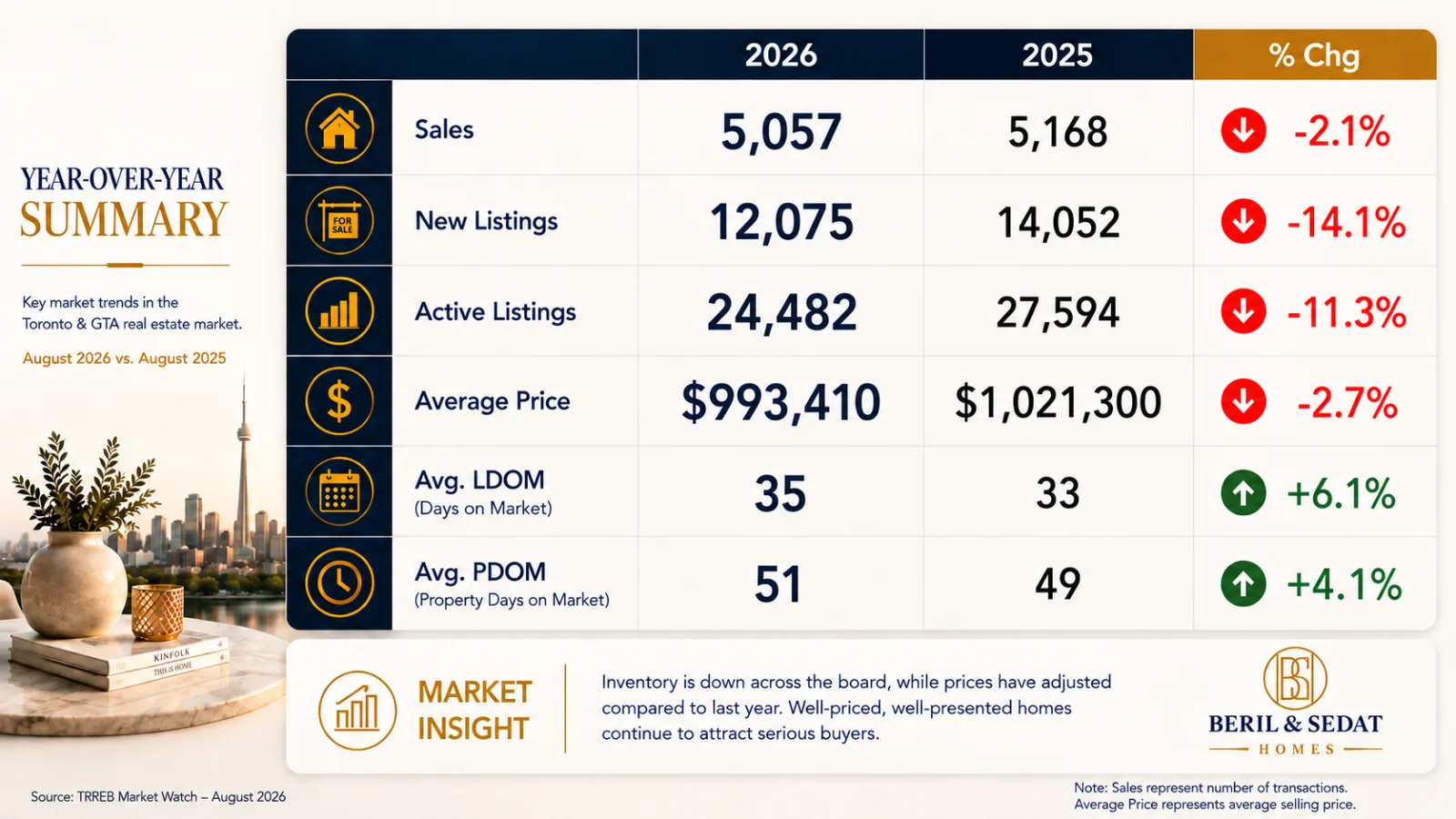
The Toronto Regional Real Estate Board reported 5,057 home sales in August, down 2.1% compared to August 2025. The average selling price across the GTA was $993,410, down 2.7% year-over-year — notably smaller than July's 4.5% annual decline, and the smallest year-over-year price drop recorded in any month of 2026 to date. The MLS Home Price Index Composite Benchmark, which strips out some of the swings caused by the specific mix of homes sold in a given month, was down 4.5% year-over-year across the GTA (3.7% in the City of Toronto specifically), with a benchmark price of $925,900. On a seasonally adjusted month-over-month basis, the benchmark was essentially flat compared to July, suggesting prices may be stabilizing rather than continuing to slide.
Homes that sold did so in an average of 35 days, up 6.1% from a year ago, with final sale prices landing at about 97% of asking on average — buyers are still negotiating, but sellers who price realistically are getting close to their number.
Supply Keeps Tightening — What That Means Going Forward
The clearest trend in August's numbers isn't about price, it's about supply. New listings fell 14.1% year-over-year to 12,075 — the seventh consecutive month where new supply has declined meaningfully. Active listings, the total pool of homes available for sale at any given moment, dropped 11.3% year-over-year to 24,482.
When new listings fall faster than sales, as they have for months now, the market gradually tightens even if sales volume itself isn't growing. That's largely what's behind the slowing pace of price declines: fewer new sellers coming to market means less competitive pressure pushing prices lower, even with demand still relatively measured. If this pattern continues into the fall — historically GTA's second-strongest selling season after spring — it would not be surprising to see price declines continue to narrow further, or reverse in specific segments first.
Detached, Semis, Townhouses, and Condos: A Market of Two Speeds
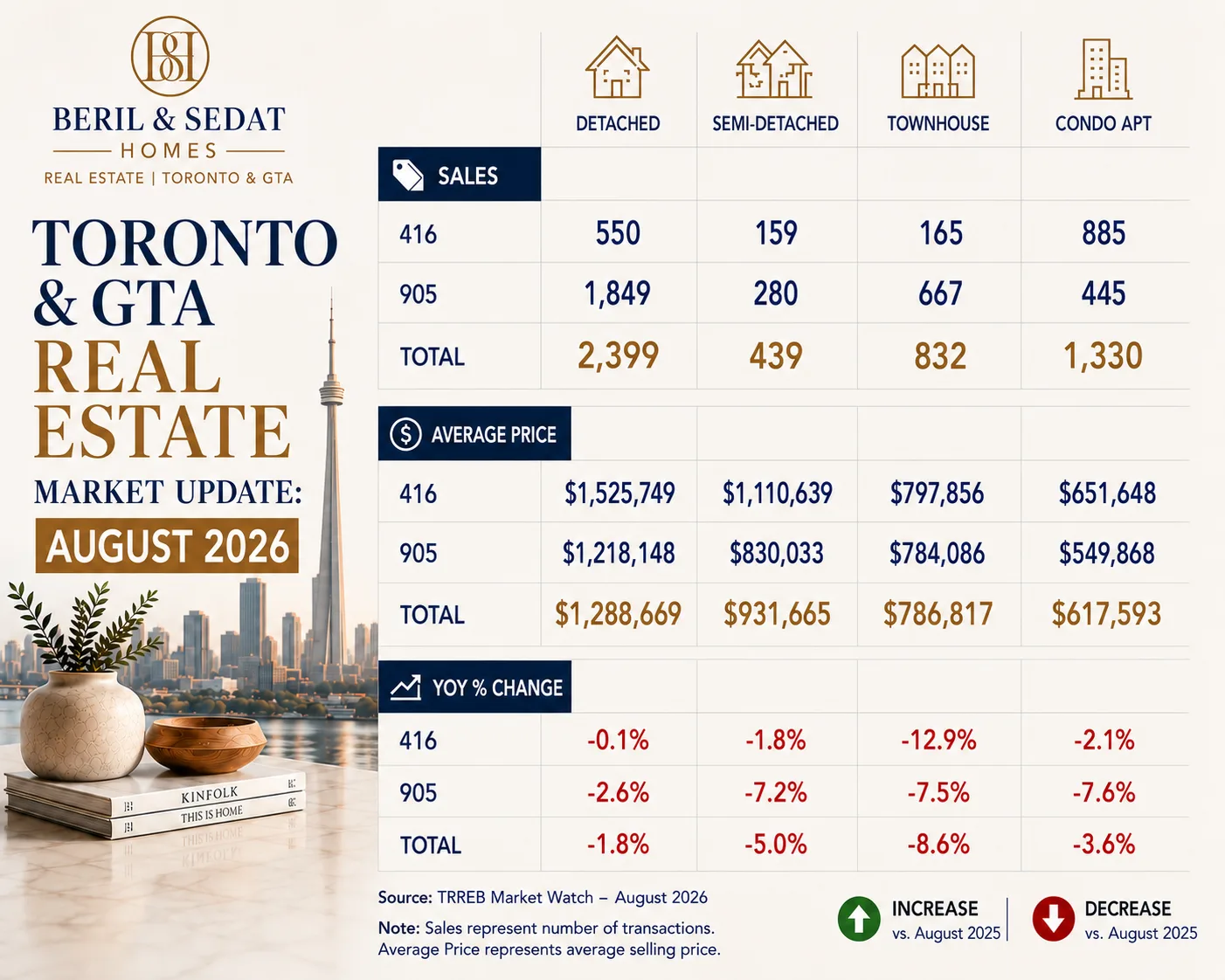
As in recent months, the story looks different depending on property type. Detached homes accounted for the largest share of August sales at 47.4%, with an average price around $1.29 million. Condo apartments were the second most active segment at 26.3% of sales, averaging roughly $618,000 — reflecting both a lower price point and a segment that continues to see softer demand. Townhouses made up 16.5% of sales at an average of $882,060, and semi-detached homes were the smallest share at 8.7%, averaging $931,665; condo townhouses averaged $681,447.
This lines up with what we highlighted in our July update: low-rise property types (detached, semi-detached, and freehold townhouses) have generally been holding up better on both pricing and pace of sale than the condo segment, where elevated inventory continues to give buyers more negotiating leverage and more time to decide. If you're selling a low-rise property, August's tightening supply is generally working in your favour. If you're selling a condo, pricing and presentation remain more important than ever given the level of competing inventory.
If you'd like to understand what it takes to sell a property nowadays and how Beril & Sedat Homes can help, click here: My House Isn't Selling in Toronto — Should I Lower the Price? | Beril & Sedat Homes
Interest Rates: Bank of Canada Holds Again
The Bank of Canada held its overnight rate at 2.25% on September 2 — its seventh consecutive hold — keeping the prime rate at 4.45%. Five-year variable mortgage rates are sitting near 3.35%, with most forecasts now suggesting rates stay roughly where they are through the rest of 2026 rather than declining further, with the next Bank of Canada announcement scheduled for October 28. Market expectations have shifted somewhat over the summer: rather than pricing in further cuts, most forecasters now see the Bank's next move — whenever it comes — as more likely to be a hold or eventual increase than an additional cut.
For buyers, this means the "wait for lower rates" calculation looks less compelling than it did earlier in the year. Financing costs appear to have found a stable floor for now, which is part of why we're starting to see the pace of price declines slow across most property types.
Frequently Asked Questions
Did home prices go up or down in Toronto in August 2026?
Prices were still down year-over-year — the average selling price fell 2.7% and the benchmark price fell 4.5% across the GTA compared to August 2025. However, this was the smallest annual decline recorded in any month so far in 2026, and prices were essentially flat compared to July on a seasonally adjusted basis.
Is Toronto's real estate market inventory getting tighter?
Yes. New listings fell 14.1% year-over-year in August, the seventh straight month of meaningful declines, and active listings fell 11.3%. This tightening supply is a key reason the pace of price declines has been slowing.
What does the Bank of Canada's rate hold mean for buyers?
The Bank held its policy rate at 2.25% for a seventh consecutive decision in September, and most forecasts now expect rates to stay roughly stable through the rest of 2026. That gives buyers more certainty around financing costs, which can make it easier to plan a purchase without waiting on a rate cut that may not materialize this year.
Which property types are performing best right now?
Detached homes, semi-detached homes, and townhouses have generally been holding value and moving faster than condos, which continue to face more competing inventory and softer demand. Condo apartments made up over a quarter of August sales at a notably lower average price point.
Is now a good time to buy or sell in the GTA?
It depends heavily on your specific neighbourhood and property type. Tightening supply is generally favouring sellers of low-rise homes, while buyers — particularly in the condo segment — still have more negotiating room and more time to decide than they did a year or two ago.
Every month brings a slightly different picture depending on where you're buying or selling and what type of property you're dealing with — the citywide averages only tell part of the story. As Beril & Sedat Homes, We're happy to walk you through what these numbers actually mean for your specific neighbourhood and situation, and if financing is part of the equation, our in-house mortgage broker, Sedat Topcu, can help you understand exactly where you stand given the current rate environment.
About Beril & Sedat Homes
Beril & Sedat Homes is an award-winning real estate team serving Toronto and the Greater Toronto Area. Founders Beril Topcu and Sedat Topcu are bilingual Turkish- and English-speaking realtors with Royal LePage Signature Realty. With more than 20 years of combined experience, over $100 million in career sales volume, and more than 200 clients served, they help buyers, sellers, investors, and newcomers navigate Toronto and GTA real estate with confidence. Their expertise spans luxury homes, condominiums, detached homes, investment properties, downsizing, upsizing, and first-time home purchases. Recognized as Executive Circle members and ranked among the top 2% of agents, they're known for personalized guidance, strategic negotiation, and in-house mortgage support through Sedat Topcu, a licensed real estate broker and mortgage broker.